My journey around the world, reviewing 50 films from different countries. New reviews every Tuesday.
Showing posts with label horror. Show all posts
Tuesday, 8 May 2012
#35 South Africa — Dust Devil (1992)
Sorry for the delay on this one, university has a way of stopping me from watching films. Note that this review is on the "Final Cut" of the film, which I hear is far superior to the theatrical version.
Perhaps a film where the tagline is "He's not a serial killer, he's much worse" looks a bit out-of-place among the other titles I've reviewed. I might agree with you there, but don't let that put you off watching what is actually a very atmospheric and artistic horror film.
The eponymous villain is a shapeshifter who preys on those who have nothing left in life. When a woman named Wendy runs away from her abusive husband, she picks up the Dust Devil and a series of grisly and surreal events occur.
The plot is fairly predictable, but has a number of interesting features to do with African witchcraft and is set against the background of racial tension in South Africa. But the focus of the film is undoubtedly on the atmosphere rather than the storyline.
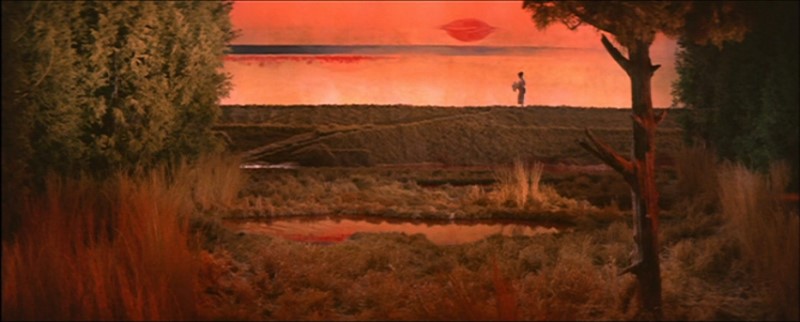
Although the genre here is definitely supernatural horror, the film's feel seems influenced by artists such as Sergio Leone and Peter Weir on top of the ones you might expect, like Carpenter, Argento, Fulci and Bava. The result is a slow-paced dreamy haze over supernatural creepy imagery and spatterings of gore. The main components of the former part are Simon Boswell's drifting, haunting score, and Steven Chiver's imaginative, beautiful cinematography.
Stanley's direction is assured and well-paced. Character development segments are mixed up with surreal dream sequences and atmospheric long takes of the desert, making a cohesive and well-structured film.
Unfortunately, the acting lets the film down in some places, especially that of the police captain who is trying to catch the Dust Devil. A lot of it feels unnatural and forced. However, Robert Burke plays the part of the villain excellently, being both cold and intense.
Dust Devil has picked up something of a cult following in recent years and it is easy to see why. Its strong technical aspects and dreamy, haunting atmosphere make it a solid thinking-man's western-tinged horror film. The predictable plot and suspect acting damage it somewhat, but if what I've described sounds like your kind of film, I'd recommend checking it out.
Labels:
1992,
arthouse,
cinema,
desert,
Dust Devil,
film,
horror,
movie,
review,
Richard Stanley,
Stanley
Tuesday, 22 November 2011
#6 Czech Republic/Slovakia ‒ The Cremator (1969)
A note about the country: perhaps I am cheating here by lumping the two countries together, but the film was made when Czechoslovakia existed in Prague (which is now in the Czech Republic), the dialog is in Czech, but the director is Slovak. The film is also considered part of the Czechoslovak New Wave, so I think you'll allow me to join the two.
Why I chose this: I've only been getting into Czechoslovak cinema recently, despite the love for Jan Svankmajer's shorts which I developed years ago. The Cremator seems to be a perfect mix between the visual style of Svankmajer, coupled with the political mindset and absurdist humor of the New Wave. I hope it will lead more people into discovering another pocket of cinema.
The Cremator is a hard film to place. It is so original and bizarre that it is difficult to pidgeon-hole it into a certain genre or even mood. If I had to describe it in one sentence, it would be something like "A pitch-black surrealist, political horror-comedy".
It follows the titular cremator, Kopfrkingl, as he slowly gets dragged into the arms of Nazism and descends into madness. He is obsessed with his duties; believing - due to his love of Bardo Thodol, the Tibetan Book of the Dead - that by cremating the deceased, he is freeing their souls to go up into the ether. Prolific Czech actor Rudolf Hrusínský plays him absolutely perfectly. His voice fits the film to a tee; it is dark, deep and monotonous, but also sadistically gleeful, like a child past his years burning ants with a magnifying glass.
Kopfrkingl's voice and mannerisms coupled with the stark, angular image compositions and surreal imagery create an atmosphere which is very dense and chilling, but the dialog and absurd characters underline it with a delishiously dark sense of humour; a husband gets frustrated by a wife whom bursts into tears for ridiculous reasons whenever he takes her anywhere and Kopfrkingl repeats sentence fragments throughout the film in a very Coenesque fashion. The comedy works in a similar way to that in cult classic Man Bites Dog, in that it will revolt some and greatly amuse others.
The sets and cinematography are stunning. Clearly influenced by German expressionism and the absurdo-Gothic trappings of Svankmajer. Each image is thoughtfully composed and some - like the Brothers Quay state in their introduction to the film - are like daggers to the eyes.
The editing work is fantastically eccentric. If Black God, White Devil (#3 in the series) was edited by Edward Scissorhands, this was edited by a brilliant, mad surgeon who forgot to take his pills. Shot lengths are all over the place, some lasting half a minute or so and some, not even a tenth of a second. This plays on the madness of the central character beautifully and adds to the unnerving atmosphere.
The film works in equal measures as a cutting political and historical portrait, a disturbing exploration of madness and (literal) God complex, a blacker-than-black comedy and an atmospheric and chilling horror. If any of the above appeal to you, then put The Cremator right to the top of your watchlist; it is not a work to be missed.
Also recommended from Czech Republic/Slovakia:
Jan Svankmajer (Pretty much all of his films are worth a watch)
Jaromil Jires (Valerie and her Week of Wonders, The Joke)
Frantisek Vlacil (Marketa Lazarova, Adelheid)
Jiří Barta (The Pied Piper of Hamelin, The Vanished World of Gloves)
Oldřich Lipský (Happy End, Lemonade Joe)
Jan Nemek (Diamonds of the Night, The Party and the Guests)
Tuesday, 15 November 2011
#4 Japan – Horror Special
An extra special Halloween feature this time
Why I chose these: I found it absolutely impossible to choose one Japanese film to write about. I've probably seen more Japanese films that any other country in the past few years so I have quite a number of favourites. Since it's horror season, I felt that an ensemble review of some of my favourite Japanese films in the genre would both be fitting and allow me to praise as many films as possible.
Note: This article doesn't seek to provide anywhere near a broad overview of Japanese horror, simply the films which I personally enjoy. If you want a more in-depth discussion of the subject, I would greatly recommend the Introduction To Japanese Horror Film by Colette Balmain and Japanese Horror Cinema by Jay McRoy.
Japan's love for supernatural stories goes back far further than the films it has produced. Ghost stories (or kaidan) were popular in the Edo period, where they would be read out in a room of a hundred candles, one extinguished after each story.
Perhaps the first Japanese horror film (although it is more a supernatural drama) was Kenji Mizoguchi's Ugetsu Monogatari in 1953. Ugetsu is a beautiful and heartbreaking work by one of the country's greatest directors and is still considered among the finest Japanese films of all time. Although - like all of Mizoguchi's films I have seen - I respect Ugetsu, it isn't among my favourites. To find these, we will need to jump forward to 1964, in which two films which I consider the very best in the genre were made.
If you ask an average film buff who their favourite classic Japanese director is, 99% of the time it will be either Akira Kurosawa, Kenji Mizoguchi or Yasujiro Ozu. I would argue that these viewers haven't seen enough Masaki Kobayashi films. I find it impossible to name a favourite of his; Hara Kiri, Samurai Rebellion and The Human Condition trilogy are all among the finest films produced in any country. If I was pressed, however, I might name Kwaidan. In stark contrast to the minimalistic black and white of his previous films, Kobayashi's first venture into colour is among the most dazzling and expressionistic ever made. The gorgeous hand-painted backgrounds, slow pace and incredible score (by the incomparable Toru Takemitsu) give the film a magical fairy-tale feel. For a film to keep up the incredible atmosphere and sense of wonder for an hour and a half would be an amazing feat; Kwaidan manages it for a whole three hours over its four separate ghost stories. If you see one film I mention in this review, make it Kwaidan.
Some directors and actors have successful careers which span an incredible length of time; Lillian Gish acted for an incredible 75 years with some of the best performances in film history, the late Sidney Lumet made two of his best films 50 years apart. Kaneto Shindo is another such artist. He made his first film in 1951 (the same year as Lumet, incidentally) and was honoured with a nomination for the top prize at Cannes the next year. He is currently 99 years old and his most recent film is Japan's entry to the Academy Award's Best Foreign Language Film category. Along the way, he has made some of the country's greatest pictures. In 1964 he released Onibaba (meaning demon woman), which still stands as one of the genre's most controversial and influential works. It is inarguably more scary than Kwaidan or Ugetsu and much less compromising in its execution. The high-contrast black-and-white cinematography is as beautiful as the content is ugly, colliding with the rapid editing, angular shots and frenzied taiko drum soundtrack to create an truly unnerving atmosphere.
Four years later, Shindo created a companion piece to Onibaba with Kuroneko (The Black Cat). Kuroneko is its predecessor's visual equal, containing more chiaroscuro lighting in succulent widescreen black-and-white. It is more deliberately paced, building the tension and eerie atmosphere rather than assaulting the viewer. It is arguable which is the better film, but I find myself more drawn towards Kuroneko for its more refined and pure viewing experience.
Now for one of the most original, outrageous and fun films I've had the pleasure of viewing: Nobuhiko Obayashi's House (1977). House can best be described as ultra-cheesy teen-pop adventure mixed with phantasmagorical horror. It's as if someone took a colourful children's book, interlaced scenes from The Shining and directed it in the middle of a particularly bad acid trip (which, if you read up on the film's production doesn't sound too far-fetched). It has everything from a bear working at a noodle bar to a man getting turned into a pile of bananas because he doesn't like watermelon. That's only the start of House's crazy goings-on. The colours are especially vivid and are splashed around all over the frames. Special effects are very predominant, but they look like they were made by a child (which I understand was actually the director's ambition) and add to the surreality of the film. Anyone with a taste for the unusual owes it to themselves to watch House. It is utterly unique and not to be missed.
Whilst on the subject of incredibly insane pictures, it would be a crime not to mention Tetsuo: The Iron Man. David Lynch's Eraserhead is perhaps the only film which can stand next to it in terms of unnerving strangeness (yes, I have seen Death Powder and I think it's awful). The plot is secondary to the surreal visuals, raw industrial music, stop motion effects and disturbing horror sequences. There isn't too much that I can actually write about this film, it just needs to be experienced.
When it comes to contemporary Japanese horror, (or J-Horror as it is often now referred to as) there are many influential directors who have made a great impact in the Western world as well as back home. Takashi Shimizu, Hideo Nakata, Takashi Miike and Sion Sono are among names often mentioned. I myself find myself drawn to the more thematically interesting and humanistic works of Kiyoshi Kurosawa, especially Pulse. Rather than simply setting out to scare people, Pulse is more an exploration of loneliness and alienation in a horror setting. That isn't to say it's not scary - it most certainly is. The atmosphere and horror build up at a very slow pace and provide the perfect bleak setting for the themes. Fans of subtle but very creepy intelligent horror should watch it the first chance they get.
Although South Korea has recently had a better track record in Horror, Japan has a rich and diverse history in the genre which is well worth exploring all corners of. Any recommendations for films which haven't been mentioned are welcome in the comments section.
Recommended from Japan:
Masaki Kobayashi (Kwaidan, Samurai Rebellion, The Human Condition, Hara Kiri)
Takeshi Kitano (Hana-Bi, Sonatine, Dolls, Kikujiro)
Akira Kurosawa (Stray Dog, High and Low, Dersu Uzala)
Kaneto Shindo (Onibaba, Kuroneko, Naked Island)
Mikio Naruse (A Woman Ascends the Stairs, Late Chrysanthemums)
Kon Ichikawa (Fires on the Plain, The Burmese Harp, An Actor's Revenge)
Hiroshi Teshigahara (Pitfall, Woman in the Dunes, The Face of Another)
Yasujiro Ozu (Tokyo Story, Late Spring, Floating Weeds)
Shinya Tsukamoto (Tetsuo: The Iron Man, A Snake of June)
Nobuhiko Obayashi (House)
Shuji Terayama (Emporer Tomato Ketchup, Grass Labyrinth)
Toshio Matsumoto (Funeral Parade of Roses)
Shohei Imamura (Ballad of Narayama, Vengeance is Mine, The Eel, Profound Desires of the Gods)
Kenji Mizoguchi (Ugetsu Monogatari, Sansho the Bailiff)
Nagisa Oshima (In the Realm of the Senses, Empire of Passion)
Hayao Miyazaki (Spirited Away, Princess Mononoke)
Kiyoshi Kurosawa (Pulse, Cure, Tokyo Sonata)
#1 Sweden – Persona (1966)
This review marks the first of many to come. I have set myself an aim to watch and review a film from as many countries as possible for the St. Andrews Award and my own pleasure. The initial target is fifty, but that may increase depending on how I feel.
Why I chose this: Tracing my love for foreign, artistic and generally weird films back to one picture leads me to Ingmar Bergman’s Persona. I took this out of the University library on a whim after an online recommendation and was awestruck from the initial montage. It seems a perfect choice for my first review, so here commences my epic journey around the world of film.
Bergman has made a great number of influential, complex and beautiful films, but Persona stands among the most singular of his works. It concerns Elizabeth Vogler (the incomparable Liv Ullman), a stage actress who suddenly turns mute during a performance. She is committed to a hospital, where a nurse named Alma (Bibi Andersson) is put in charge of her. When they are sent away for a respite at a secluded summer house by the beach, Alma confides all her cares and fears to Elizabeth and their identities become blurred.
The film – as most created by Bergman – is less about the story and more about the questions which it asks and the answers which it gives (or doesn’t give). The explorations of identity, motherhood, art and the human psyche are deep and complex, requiring multiple viewings to truly appreciate.
If philosophical musings aren’t your cup of tea, then the film can simply be experienced passively as a work of art. The cinematography of frequent collaborator Sven Nykvist is breathtakingly beautiful; he captures every expression on the actresses faces perfectly and composes each frame with the skill of a master artist. The lighting at once seems natural and dreamlike. This is particularly notable in a scene near the beginning of the film where Elizabeth’s face as she lays on her bed slowly darkens as light leaves the room. The shot is both beautiful and terrifying.
Bergman has a knack of coaxing the best possible performances from his cast and this skill is displayed to its full power here. Alma seems completely open, innocent and full of vitality. As the film climaxes however, we witness a venomous, grudging side of her. Bibi Andersson plays both of these parts perfectly; exposing an almost childish naivety with animalistic reactions to hurt and betrayal. Liv Ullman is silent for almost the whole film, but gets across more
emotions than most could dream of with just her face.
Persona is a film which has remained a favourite of mine and one which I take something new from every time I watch it. If you like your films dense, beautiful and atmospheric, I urge you to watch it.
Also recommended from Sweden:
Any other Bergman film
Roy Andersson (Songs from the Second Floor, You the Living)
Lukas Moodysson (Lilja 4-Ever, Show Me Love)
Tomas Alfredson (Let The Right One In)
Körkarlen (The Phantom Carriage)
Subscribe to:
Posts (Atom)